
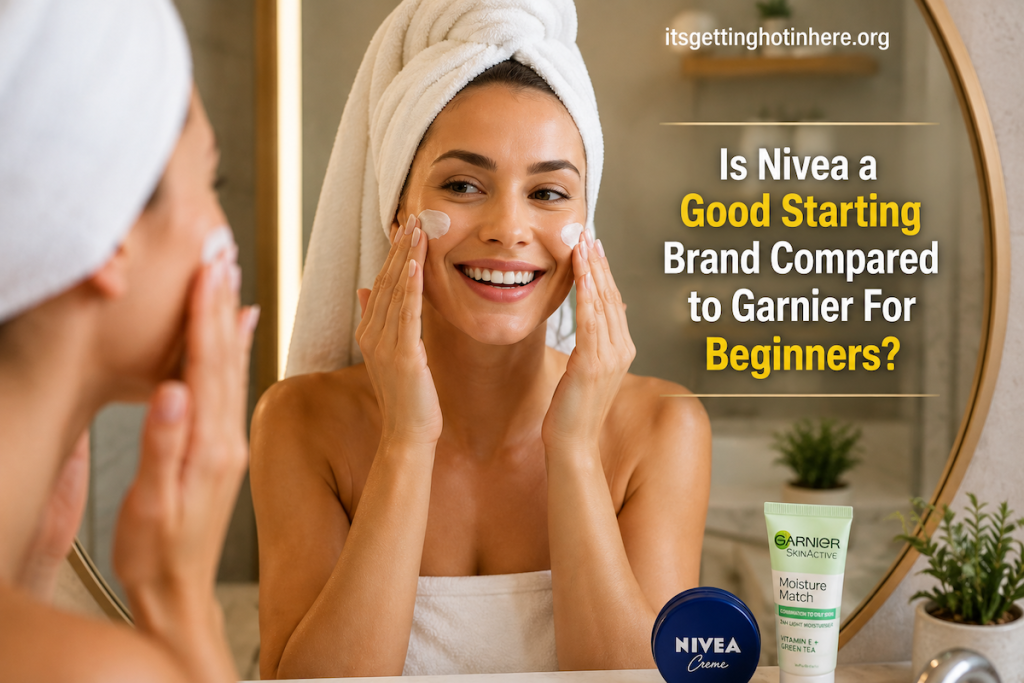
You are standing in front of the shelf. Blue tin in one hand, green bottle in the other, and both of them look perfectly reasonable.
You have probably already typed some version of it into your phone: I’m a skincare beginner, is Nivea a good starting brand compared to Garnier? So here is the honest answer, up front rather than six hundred words down the page.
Both are fine. Neither will ruin your skin. The choice between them matters considerably less than the internet has led you to believe, and anyone telling you otherwise is padding.
What decides whether a product suits you is printed on the back of the bottle, in the bit nobody reads. That takes about five minutes to learn and you will keep it for life, which is rather more useful than a verdict on two brands whose product lines will look different by next year.
So: the short answer, then how to read a label, then what that says about these two specifically. The last section covers what to look at if you care about packaging and animal testing.
The Short Answer, and Why It Isn’t the Useful One
You came for the comparison, so here it is without ceremony.
Nivea leans towards rich, simple hydration. Its best-known products are moisturisers built around keeping water in the skin, with short ingredient lists and not much going on beyond that. It tends to suit dry or easily irritated skin.
Garnier leans towards lighter textures and active ingredients. Its range includes products built around salicylic acid, vitamin C and niacinamide, aimed at oiliness, breakouts and uneven tone. It tends to suit oily or blemish-prone skin.
That is the consensus, it is broadly right, and every article on this subject says it.
Here is why it is not enough. Both brands make dozens of products. Nivea sells lightweight lotions and gel moisturisers. Garnier sells rich creams. Choosing a brand tells you very little about the specific bottle in your hand, and the bottle is the thing that ends up on your face.
The better question is not which brand. It is which product, and that one you can answer yourself once you know what four or five words mean.
It is worth knowing why every article says the same thing, too. Both brands are enormous, both have been around for decades, and their marketing has settled into distinct territories over that time. The consensus is describing brand positioning rather than chemistry, which is why it is true in general and unhelpful in the shop.
What Your Skin Type Changes
Worth a minute, because the label-reading only helps if you know what you are matching it to.
Dry skin feels tight after washing and may flake, particularly around the nose and cheeks. Oily skin looks shiny within a few hours of cleansing. Combination skin is oily down the middle of the face and normal or dry at the edges. Sensitive skin stings, reddens or reacts easily, and can be dry, oily or combination at the same time, which is why it confuses people.
Now the part almost nobody mentions. Skin type is not fixed. It shifts with season, age, climate and what you have been putting on it. Somebody with oily skin at nineteen quite often has dry skin at thirty-five. A routine that worked beautifully last winter may not suit this one, and that is normal rather than a sign you have done something wrong.
The test costs nothing. Wash your face, put nothing on it, wait an hour, then notice how it feels. Tight means dry. Shiny means oily. Both in different places means combination. That is the whole diagnostic.
Do it more than once, ideally on a couple of different days. Skin has off days like the rest of us, and one reading taken the morning after a late night is not a diagnosis.
The Eight Words That Do Most of the Work
This is the part worth keeping. Learn these and you can walk into any shop in any country and judge a product without needing anyone’s opinion.
- Glycerin. A humectant, meaning it draws water into the skin. It appears in almost everything, costs very little, and is well tolerated by nearly everyone. Seeing it high on a list is a good sign for most skin types.
- Hyaluronic acid. Another humectant, capable of holding a lot of water. Feels light rather than rich, which is why oily skin often gets on well with it.
- Niacinamide. A form of vitamin B3, commonly used in products aimed at oiliness, uneven tone and general barrier support. Generally well tolerated and a sensible first active for most people.
- Salicylic acid. An exfoliating acid that works inside the pore rather than on the surface, commonly used in products aimed at blackheads and congestion. Start two or three times a week rather than daily.
- Vitamin C, or ascorbic acid. An antioxidant commonly used in brightening products. Effective and among the more likely to sting on sensitive skin, so introduce it slowly.
- Shea butter and similar emollients. Rich ingredients that sit on the surface and slow water loss. Excellent for dry skin, potentially heavy and pore-clogging for oily skin.
- Fragrance, or parfum. Extremely common, entirely legal, and one of the more frequent causes of irritation in reactive skin. If your skin objects to things, this is the first word to look for.
- Alcohol denat. Not automatically a problem, and it is what makes some textures feel light and fast-absorbing. High up the list on an already dry face, it can feel drying.
One fact makes all of that usable in about ten seconds. Ingredients are listed in order of quantity. Anything in the first five is present in a meaningful amount. Anything in the last five almost certainly is not, however prominently it appears on the front of the packaging.
That is why a serum advertising vitamin C can list it eleventh, and why the word on the front tells you what the marketing department wanted you to notice rather than what is in the tube.
You do not need to recognise every word on a list, and nobody does. Scan the first five, look for the one or two you were hoping for, and check whether fragrance is high up if your skin is reactive. Ten seconds, and you have learned more than the front of the box was ever going to tell you.
What Nivea and Garnier Each Emphasise
Now put the method to work on the two brands you asked about. Both ranges are large and both change, so this describes emphasis rather than a catalogue.
| What you want | Nivea tends to offer | Garnier tends to offer |
|---|---|---|
| Basic hydration | Rich creams built around emollients and glycerin | Lighter moisturisers, often with added actives |
| Lightweight hydration | Gel and lotion formats, fewer of them | A wider choice, frequently with hyaluronic acid |
| Oil and shine | Fewer options aimed specifically at this | A core strength, with lightweight mattifying textures |
| Blemishes and congestion | Not the brand’s main focus | Products built around salicylic acid and similar |
| Brightening and uneven tone | Limited | A well-known vitamin C range |
| Cleansing and makeup removal | Cleansing milks and simple washes | Micellar water, widely used and well regarded |
Notice that most rows have something in both columns. Neither brand has an empty category, which is the point. You are choosing between two specific products, not between two companies, and both companies make something that would suit you.
The Three Products That Are the Answer
A complete beginner routine is three things. Something to wash with, something to moisturise with, and sunscreen.
That is not a simplified version for beginners. That is the routine, and a great many people with excellent skin never add anything to it. Everything else is optional, and most of it is optional permanently.
If you only care about one of the three, care about the sunscreen. It does more for how skin looks over ten years than any serum will, and it is the single product where the evidence is not remotely controversial. Wear it on days you are not going anywhere interesting.
When you do want to add something, add one thing at a time and leave two weeks before the next. If your skin objects, you will know exactly which product caused it. Add three at once and you will be throwing away all three, or worse, keeping the culprit and binning the two that were fine.
A remarkable number of people with complicated routines and permanently irritated faces got there by buying faster than their skin could keep up. Going slowly is not caution. It is the only way to find out what works.
One more thing on the three. Patch test anything new on a small area, the inside of the forearm or just behind the jaw, and leave it a day before it goes anywhere near your whole face. It feels excessive until the one time it saves you a fortnight of looking blotchy. And if your skin is persistently sore, itchy or breaking out badly, that is worth a conversation with a pharmacist or GP rather than another purchase.
Neither Is the Standard Recommendation, and That’s Fine
Worth saying plainly, because no one else on this subject does.
When dermatologists name a starting point for someone completely new, they more often reach for the plain barrier-repair brands built around very simple formulas than for either of these. Those ranges exist to do exactly this one job.
That is not a criticism of Nivea or Garnier. Both serve enormous audiences with wide ranges, and being designed for everyone is a different brief from being designed for beginners specifically.
What follows from it is reassuring rather than otherwise. If one of these is what is in front of you, affordable, and available in the shop you actually go to, it is a perfectly sensible place to start. Price and availability are real considerations, not compromises, and the best routine is the one you will still be doing in March.
There is no wrong answer here. There is only a better-fitting one, and you now have the means to find it.
If You Care About Animal Testing and Packaging
This deserves a proper answer rather than a slogan, and the honest version is about how to check rather than what to conclude.
On animal testing, Cruelty Free International maintains a public, searchable list of approved brands under its Leaping Bunny programme. Certification status changes, and it changes more often than articles get updated, so searching that list yourself takes a minute and gives you an answer that is current rather than one that was true when somebody wrote about it.
On vegan status, here is the thing almost nobody tells you: it is a per-product question, not a per-brand one. Large ranges contain both vegan and non-vegan formulations, so the brand name will not answer it.
What answers it is the ingredient list. Look for lanolin, which comes from sheep’s wool and turns up in rich moisturising creams more than anywhere else. Then beeswax, sometimes listed as cera alba. Then honey and carmine, a red pigment derived from insects. If none of those appear, the product is very likely vegan regardless of what the front of the packaging says.
On packaging, you can assess most of it standing in the shop. Does a refill format exist for this product, or only the full container. Does the bottle carry an actual recycling instruction rather than a vague symbol. Is the outer carton doing anything except making the box look bigger.
Both parent companies publish sustainability commitments on their own websites, and both are worth reading with the same scepticism you would bring to any corporate target. What is checkable in your hand beats what is promised in a report, every time.
The Least Wasteful Routine Is Also the Best Beginner Routine
Here is a genuinely uncommon situation. The advice a dermatologist gives a beginner and the advice with the smallest environmental footprint are the same advice.
Three products means three containers, three things you will finish, and three variables if something goes wrong. Eight products means eight containers, eight chances to irritate your skin, and a shelf of half-used bottles that will eventually go in the bin because you cannot remember which one you were reacting to.
Buying fewer things is better for your face and better for your bin, and those two rarely line up so neatly.
One specific note, since both brands sell it. Micellar water is genuinely convenient and it is usually used with disposable cotton pads, one or two per night, every night. That adds up to several hundred a year without anyone noticing. A washable reusable pad does the identical job and lives in the machine with your towels.
And the least glamorous habit of all, which is finishing what you buy. Skincare that gets used up is skincare that worked. Skincare that gets replaced at the halfway mark was probably never the problem.
Frequently Asked Questions
The questions that come up most often about this one.
Is Nivea good for skincare beginners?
Yes, particularly if your skin is dry or reacts easily. Its moisturisers are built around simple hydration rather than active ingredients, which makes them easy to introduce without irritation and easy to keep using.
Is Nivea or Garnier better for oily skin?
Garnier generally, because its range includes more lightweight textures and more products built around salicylic acid and niacinamide. Nivea does make lighter formats, so check the individual product rather than assuming from the brand.
Can I use Nivea and Garnier together?
Yes, and most people end up doing exactly that. There is nothing special about staying loyal to one brand, and a Garnier cleanser with a Nivea moisturiser is a perfectly ordinary combination.
Is Nivea vegan?
It depends entirely on the product rather than the brand. Check the ingredient list for lanolin, beeswax or cera alba, honey and carmine. Rich moisturising creams are the most likely to contain lanolin.
How long before I know if a product suits me?
Give a moisturiser or cleanser about two weeks, and anything with an active ingredient closer to six. Irritation shows up quickly, but improvement is slow, so judging after three days tells you very little.
Do I really need sunscreen if I use a moisturiser?
Unless that moisturiser carries an SPF, yes. If it does, check the number rather than assuming, and remember you need considerably more of it than most people apply.
Nivea or Garnier for Beginners: Pick the Bottle, Not the Brand
The verdict, in a sentence you could pass on. Nivea if your skin is dry or reacts easily, Garnier if it is oily or breaking out, and either one if neither of those describes you particularly well.
The thing worth keeping from all this is not that verdict, though. It is the label-reading, because it works on every product in every shop and it does not expire when either brand reformulates something.
Three products. One new thing at a time. Finish what you buy. That covers almost everything, and it will save you both money and the specific misery of a face that has been given eight new things in a fortnight.
So, I’m a skincare beginner. Is Nivea a good starting brand compared to Garnier? The honest answer is that either will do you perfectly well. Turn the bottle over, read the first five ingredients, and buy the one that suits the skin you actually have. The label is worth more than the logo, and it always will be.