
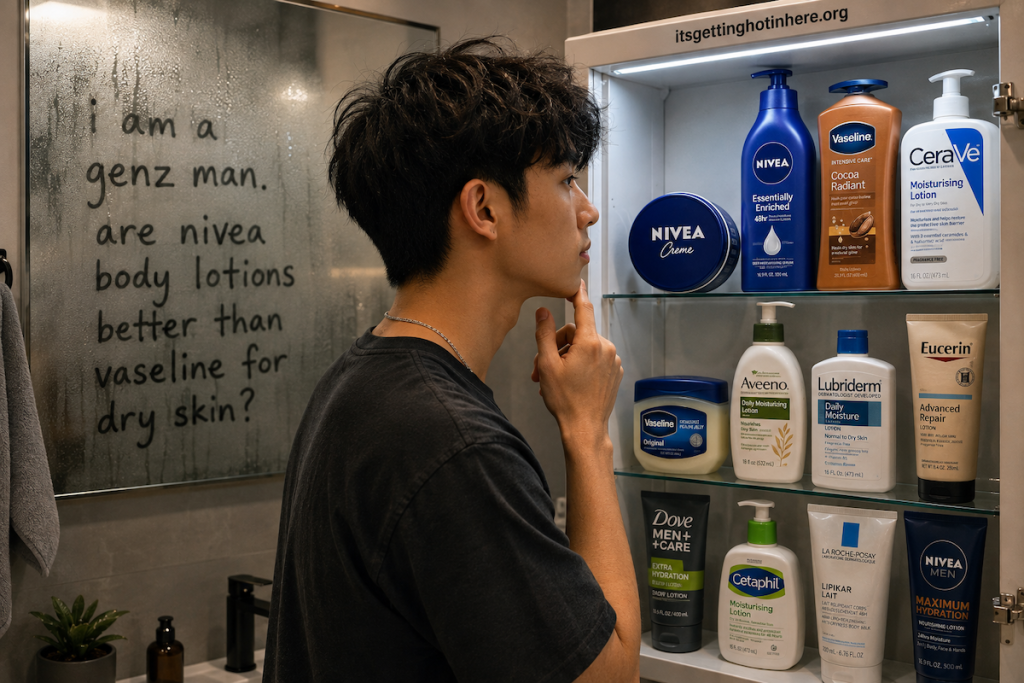
There is a tub of petroleum jelly in most bathrooms in the country, usually near the back, usually older than anyone can account for. It costs almost nothing, it never seems to run out, and half the people who own one are not entirely sure what it is for.
Which brings us to the question you probably arrived with. I am a genz man, are Nivea body lotions better than Vaseline for dry skin? It gets asked constantly and it is almost always answered badly.
Here is why. The two things are not competing products. They are different categories doing different jobs, and asking which is better is a bit like asking whether a jumper is better than a radiator. Both make you warmer. They are not alternatives.
Once you know what each one physically does, the answer becomes obvious, and it is probably not the one you were expecting.
Two Different Jobs
Skin gets dry for one basic reason: water leaves it faster than it arrives. Everything sold for dry skin is attacking one half of that or the other.
Some products add water, or pull it in from elsewhere. Some products stop water leaving. A few do a bit of both.
Petroleum jelly sits firmly in the second camp. A body lotion sits mostly in the first, with some of the second.
That single distinction explains every argument you have ever read on this subject, including the ones where both sides were right.
It also explains why the answers online contradict each other so cheerfully. Somebody with mildly dry skin in a mild climate genuinely does better with a lotion. Somebody with cracked hands from working outside in January genuinely does better with an occlusive. Neither of them is wrong and neither of them is describing your situation.
What Petroleum Jelly Actually Does
Vaseline is petrolatum. It is what is known as an occlusive, which is a technical way of saying it forms a physical barrier on the surface of your skin.
Here is the part that surprises people. It does not moisturise anything. There is no water in it, so it adds none to your skin. What it does is sit on top and dramatically slow the rate at which the water already in your skin evaporates away.
That is why it is extremely good at what it does and useless at what it does not do. Apply it to skin that is already reasonably hydrated and you will hold that hydration for hours. Apply it to skin that is bone dry and you have sealed in nothing, because there was nothing there to seal.
It also sits on the surface rather than absorbing, which is why it feels greasy and takes a while to stop feeling like something is on your arms. That is not a flaw. It is the mechanism working.
Worth knowing, since it comes up constantly: petroleum jelly does not clog pores in the way people assume. The refined stuff sold for skin is heavily purified and the molecules are too large to get into a pore in the first place. It can trap what is already there, which is why it is a poor idea on a face that breaks out, and a perfectly sensible one on shins and elbows.
What a Body Lotion Does Instead
A body lotion is an emulsion, which means water and oil mixed together with something holding them in suspension. Nivea’s lotions are built on that principle, and so is essentially every lotion you can buy.
Three kinds of thing tend to be in there. Water, which is the actual moisture. Humectants like glycerin, which pull water in and hold it. And emollients, which soften the surface and slow evaporation, though far less aggressively than petrolatum does.
So a lotion is doing both halves of the job at once, moderately, in something that absorbs and does not leave you sticking to your shirt.
The trade is straightforward. It adds water where petroleum jelly adds none, and it seals considerably less well. For most people, most of the time, that combination is the more practical one, which is why lotion outsells jelly by an enormous margin.
There is a spectrum here rather than two boxes. A light lotion is mostly water and absorbs in seconds. A thick cream sits further along, with more oil and more sealing. A body butter or ointment is further still. Broadly, the greasier something feels, the more it is doing the trapping half of the job and the less it is doing the adding half.
Why Dry Skin Usually Wants Both
If your skin is genuinely dry rather than just a bit tight in February, the useful answer is not one or the other.
Add water, then trap it. Lotion first, because it carries the moisture. Petroleum jelly over the top on the worst areas, because it holds it there. Each product does the half of the job it is built for, and neither is being asked to do something it cannot.
The internet calls this slugging, mostly in the context of faces, and it works exactly the same way on hands, elbows, heels and shins. There is no technique to learn beyond the order.
You do not need it everywhere. Most people who do this apply lotion generally and the occlusive only where the skin is worst, which for men is usually hands in winter, heels, and the backs of the arms.
If you want to test whether it is doing anything, run it on one hand for a week and not the other. It is not a rigorous experiment and it is convincing enough, because the difference on the treated side after five or six nights is usually obvious without looking closely.
The Order, and When to Do It
Three practical points, and none of them takes any time.
Apply to slightly damp skin. Straight after a shower, patted rather than rubbed dry, is the ideal moment, because there is water on the surface for the lotion to work with and for the occlusive to trap. Waiting twenty minutes wastes most of the benefit.
Put the occlusive on last. It is a barrier, so anything applied over it is largely sitting on top of a barrier rather than going anywhere useful. This is the single most common mistake and it undoes the whole thing.
Do the heavy version at night. Petroleum jelly on your hands at nine in the morning is a genuinely annoying way to spend a day. At eleven at night it is invisible, it has eight uninterrupted hours to work, and the difference by morning is the thing that converts people.
One thing that undermines all of it, and it is worth naming because it is the actual cause for a lot of people. Very hot showers strip the skin considerably faster than any product replaces. If your skin is dry and your showers are hot enough to turn you pink, turning the temperature down is a bigger intervention than anything you can buy.
If you want a version that takes about forty seconds: shower, pat dry, lotion everywhere, jelly on hands and heels, sleep.
When One of Them Is Enough
Not everyone needs both, and it is worth saying so rather than selling you a routine.
If your skin is only mildly dry, or dry only in winter, a lotion on its own will very likely be all you need. That is the normal case and there is no prize for complicating it.
If you have one or two specific areas that crack, and the rest of you is fine, the reverse works. Occlusive on those spots, nothing anywhere else. Plenty of people who work outdoors do exactly this and never own a lotion.
And if you dislike the feel of grease in any form, use the lotion, use it twice a day rather than once, and accept that you are trading a little effectiveness for comfort. That is a perfectly reasonable trade and it is yours to make.
The version that fails is the one where you buy both, use the jelly once, decide it is unpleasant, and then use neither. Consistency beats optimisation by a wide margin here. A lotion you apply every night comfortably outperforms a perfect routine you abandon in a fortnight.
If Your Skin Is Cracked, Sore or Not Improving
Worth being direct here, briefly.
Everything above is about ordinary dry skin, the kind that comes from cold weather, hot showers, hard water and central heating. That is the vast majority of it.
If your skin is cracked and bleeding, painful, spreading, or it is not improving after a couple of weeks of doing the sensible things, that is worth a conversation with a pharmacist or a GP rather than another purchase. Persistent skin problems can have causes that no lotion addresses, and a pharmacist consultation costs nothing.
It is also worth knowing that both products are commonly recommended by professionals as part of general skin care, which is different from either of them treating a condition. The distinction matters if you are trying to work out whether you have an ordinary problem or a medical one.
Nothing on this page is treatment advice, and neither of these products is a treatment for anything.
One Jar Against Six Bottles
Something worth noticing if you think about what you throw away.
Petroleum jelly is about as long-lasting as anything in a bathroom gets. It contains no water, so there is nothing in it to spoil, and a small tub used on hands and heels lasts an extraordinarily long time. Most people replace one every couple of years and only because they lost the old one.
A body lotion is mostly water, gets used in far larger quantities, and comes in a plastic bottle you will replace several times a year. That is not an argument against lotion, which does a job jelly cannot. It is worth knowing that the two products have very different lifespans per unit of packaging.
Which points at the same conclusion the rest of this article reached from a different direction. Two products used properly beats six products used inconsistently, and it will cost you less in money, in bathroom shelf space and in things going in the bin half full.
The same logic applies to the shelf generally. Skincare marketed at men has expanded enormously in the last decade, and most of what has been added solves problems the two products above already handle. A third and fourth item are usually convenience or scent rather than function.
Buy small, use it up, replace it when it is empty. That habit does more than any upgrade.
Frequently Asked Questions
The questions that come up most often about this one.
Is Vaseline better than Nivea body lotion for dry skin?
Neither is better, because they do different jobs. Petroleum jelly seals water in and adds none. A lotion adds water and seals some of it. For genuinely dry skin, using both in that order beats either alone.
Does Vaseline moisturise your skin?
Not in the usual sense. It contains no water, so it adds no moisture. What it does is form a barrier that slows the water already in your skin from evaporating, which is why it works best on skin that is already damp.
Can I put Vaseline over body lotion?
Yes, and that is the correct order. Lotion first because it carries the moisture, occlusive over the top because it holds it there. Doing it the other way round largely wastes the lotion.
Is Vaseline bad for your skin?
For most people it is well tolerated and has been used for well over a century. It does not absorb, so it sits on the surface, and some people find it too heavy or too greasy for daily use on large areas.
What is the cheapest way to deal with dry skin?
A basic lotion, a small tub of petroleum jelly, and applying both to damp skin after showering. That combination costs very little, lasts a long time, and outperforms most of what is sold at ten times the price.
Do I need a separate men’s product?
No. Skin is skin, and the differences between products marketed to men and women are mostly fragrance and packaging. Buy the one whose texture and smell you will actually put up with every day.
I Am a Genz Man. Are Nivea Body Lotions Better Than Vaseline for Dry Skin? Neither, and Both
The honest verdict is that the question has a false premise built into it. A body lotion and a tub of petroleum jelly are not two versions of the same thing, so neither one wins.
What matters is which half of the problem you are solving. If your skin needs water, a lotion is what carries it. If your skin needs that water to stay put, an occlusive is what holds it. Genuinely dry skin usually needs both, in that order, on damp skin, at night.
The two habits worth keeping are the order and the timing. Lotion first, occlusive over the top, both onto skin that is still slightly damp. Everything else on this page is detail around those two things.
None of this requires spending more. It is two cheap products, applied in the right sequence, at the right moment, which costs about forty seconds a day and nothing extra at all.
So if you are a genz man wondering whether Nivea body lotions are better than Vaseline for dry skin, the answer is that you are choosing between a jumper and a radiator. Use the lotion to put the moisture in, use the jelly to keep it there, and get on with your evening.