
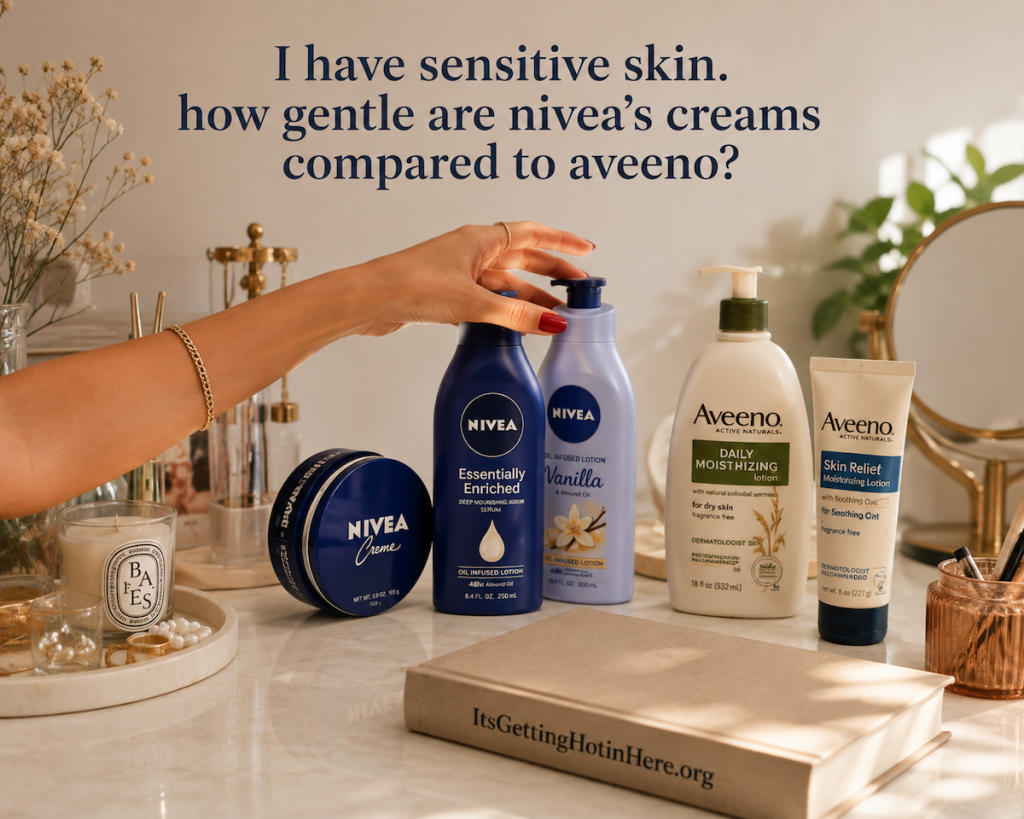
There is a particular twenty seconds that only some people know about. You have put something new on your face, and now you are standing at the mirror doing nothing at all, waiting to find out whether this one is going to be fine.
Sometimes nothing happens and you forget about it. Sometimes there is a warmth across the cheeks that you tell yourself is normal, and forty minutes later you are looking at a face that is not the one you left the house with.
If you know that pause, you are the person this is written for. You have sensitive skin, and you want to know how gentle Nivea’s creams are compared to Aveeno, because you would rather not run the experiment again.
Almost every answer you will find picks one and moves on. None of them stops to ask what you mean by gentle, and that turns out to be the whole problem, because the word is quietly doing three different jobs at once.
Separate those three and the answer becomes straightforward. Here is what the word is hiding, what each brand is built for, and the one variable that matters more than which name is on the tub.
What People Mean When They Say Gentle
When somebody calls a cream gentle, they could mean any of three things, and they are rarely the same thing.
The first is that it contains little likely to irritate. No fragrance, no essential oils, a short list of ingredients and nothing on it doing anything dramatic. This is gentleness by omission.
The second is that it supports the skin barrier rather than stripping it. The cream sits there holding moisture in and keeping the weather out, and skin that is protected tends to behave better. This is gentleness by defense.
The third is that it settles skin that is already unhappy. Not preventing a problem but arriving after one has started. This is the one most people actually mean when they go looking, and it is the one least often delivered.
The distinction is practical, not pedantic. A cream can be excellent at the second and do nothing whatsoever for the third, and somebody who bought it hoping for calm will decide it failed. It did not fail. It was never built for that.
The three can also pull against each other. The formulas that hold moisture in best tend to be the heaviest, and heavy is not what most irritated skin wants sitting on it. The shortest ingredient lists tend to belong to products that do one job only. Nothing here is a free choice, which is why no single cream is the gentlest by every definition at once.
Which is where these two brands separate, because they are built around different ones.
What Nivea’s Creams Are Built For
Nivea is built for the second meaning, and it is very good at it.
The blue tin is the archetype of the whole approach. A thick, rich, unglamorous formula with a short ingredient list that has barely changed in decades, because it never needed to. It does one thing: it forms a layer that holds moisture in. That is not a modest achievement, it is most of what dry skin needs, and it explains why the tin has survived a century of the industry reinventing itself around it.
The wider range works on the same principle at different thicknesses. Lighter lotions for people who cannot bear the tin, richer creams for winter hands, the same underlying idea throughout. What you almost never find is a Nivea product built around calming something, because that has never been the pitch.
Where it sits on the three meanings: strong on the second, neutral on the third. Nivea is not trying to calm anything and does not claim to. If your skin is dry, tight and otherwise behaving, that is exactly the right tool and there is no reason to spend more.
One thing does need saying, and it is the most useful sentence in this section. A great deal of the Nivea range is scented, and for reactive skin fragrance is the most common trigger there is. The brand also makes unfragranced options. That is a choice you make inside the brand, not a reason to avoid it.
Who it suits: skin that is dry rather than angry.
What Aveeno Is Built For
Aveeno is built for the third meaning, and it is the only one of the two that is really trying to be.
The whole brand is organized around colloidal oatmeal, an ingredient long used in products aimed at skin that is already irritated. The name comes from it. The packaging is about it. The range is arranged around people whose skin reacts rather than people whose skin is merely dry, and that focus is unusual enough to be the reason the brand exists at all.
Being careful here matters more than being enthusiastic. What can be said is what the brand is built around and what the ingredient is commonly associated with. What cannot be said is what it will do to your face, because nobody writing a web page knows that about your face.
Where it sits on the three meanings: aimed squarely at the third, and perfectly competent at the second. It moisturizes fine. That is not what you are paying the premium for.
There is a quieter benefit to a brand with that focus, and it is worth naming. When a range is designed for people whose skin reacts, the boring decisions tend to have been made with those people in mind: the unfragranced options are easy to find, the labeling says what it means, and you spend less time squinting at the back of a tub in a store.
The trade, with no judgment attached: the range is narrower, it generally costs more per unit than Nivea, and the oat scent is still a scent. Most people find it barely there. A small number do not.
Who it suits: skin that flares rather than skin that merely feels tight.
The Variable That Matters More Than the Brand
Here is the part that would have saved you the bad afternoon, and almost nobody says it.
Both brands sell fragranced and unfragranced products. For reactive skin, the fragranced version of either is more likely to cause you trouble than the unfragranced version of the other. The variable is inside the brand, not between the two brands.
Which means somebody comparing Nivea against Aveeno while ignoring which version she picked up is comparing the wrong thing entirely. It also explains something that looks like chaos from the outside: two people can have completely opposite experiences of the same brand and both be telling the truth, because they were not using the same product.
You do not need to learn anything to act on this. The relevant word is printed on the front of most of these tubs, not hidden in the small type, and it takes about two seconds to check. It is also the cheapest change available to you, since the unfragranced version of a product almost never costs more than the scented one.
So the question is not really which brand is gentler. It is which version of which brand, chosen for what your skin is doing. And whichever you choose, patch test it on the inside of your forearm for a day first, because a day of waiting is a much better deal than a fortnight of regret.
Which One for Which Skin
Sorted by what your skin is doing on the day you are asking, which is the only way this sorts properly, and it may well change by season.
If your skin is dry, tight and otherwise calm, go with Nivea, unfragranced. You are asking for moisture to be held in, that is precisely what the range is built to do, and it will be the cheaper answer by a clear margin. Paying more here buys you very little.
If your skin goes red, itchy or blotchy, Aveeno is the more sensible starting point, because the entire range is designed around that situation instead of treating it as an edge case. You are paying for a narrower focus, and a narrower focus is what you want when something is already going wrong.
If your skin does both, at different times of year or on different parts of your face, you are like most people. The honest answer there is one of each, used for different jobs instead of swapped around at random. Nivea when things are quiet and dry, Aveeno when they are not. That is not indecision, it is using two tools for two problems.
One thing worth saying plainly, and then not repeating. If your skin is reacting persistently instead of now and then, that is worth a look from a doctor or a pharmacist. No cream is the answer to a pattern, and finding out what is going on beats working through the shelf one tub at a time.
The Cheapest Thing You Can Do for Sensitive Skin
There is a move that costs nothing, and it is the one most people try last.
Use fewer things.
Reactive skin is the one situation where the fix is usually subtraction rather than addition. Every product you take away is one fewer suspect, and if you are using six things there is no way to know which of the six is the problem. Strip it back to a cleanser and a moisturizer for a fortnight and the answer often presents itself without you doing anything clever.
This is the rare case where the effective move and the frugal one and the low-waste one are the same move. Not because buying less is virtuous, but because subtraction is genuinely the method here, and the saving is incidental. The smaller shopping basket is a side effect.
None of this means throwing anything away. It means parking most of it in a drawer for two weeks and seeing what your face does with the quiet. If everything settles, you reintroduce one thing at a time and you learn something. If nothing changes, you have ruled out your whole shelf in a fortnight, which is genuinely useful information.
It is also the least satisfying advice in skincare, which is probably why it gets skipped. There is nothing to buy at the end of it.
What Sensitive Skin Is and Is Not
Worth knowing, because it explains why the advice you have read contradicts itself so relentlessly.
Sensitive skin is a description of how skin behaves, not a diagnosis. There is no test for it. Nobody hands you a result. It is a word people use when their skin reacts to things more readily than they would like, and the things it reacts to vary enormously from person to person.
Which means two people can both have sensitive skin and need opposite products, and both can leave reviews saying the same cream is either the best thing they have used or the worst. Neither is lying. They were never describing the same condition, because it is not one condition.
The practical consequence is that the only reliable evidence about your skin is what your skin has already done. Keeping a rough note of what caused a reaction, even scribbled in your phone, will outperform every brand recommendation you read, including this one. Six months of notes is a better guide than any review site, because it is about you.
You are the only person running the experiment that matters, and you are already running it whether you write anything down or not.
Frequently Asked Questions
The questions that come up most often once someone has got this far, answered straight.
Is Aveeno gentler than Nivea?
For skin that is already reacting, Aveeno is built for that job and Nivea is not. For skin that is simply dry, neither is gentler in any meaningful way. The word only settles once you decide which kind of gentle you need.
Can I use Nivea on sensitive skin?
Plenty of people do, successfully, for years. Choose an unfragranced option, patch test it, and judge it on what your own skin does. The brand is not a problem in itself, and the fragranced versions are the part worth being careful about.
Is Nivea Creme good for sensitive skin?
The classic tin is a short-ingredient, heavily occlusive cream, which suits some reactive skin very well and feels far too heavy for others. It is scented, which is the part to weigh. Trying it on your forearm first costs you a day.
Which is cruelty-free?
Sadly, none of them is, and both products are known to test on animals, and that does not seem to be changing any time soon.
Which is better value?
Nivea is cheaper per unit, and it is not close. Aveeno costs more because you are buying a narrower focus. If that focus is what your skin needs, it is good value. If it is not, you are paying for something you will not use.
Can I use both?
Yes, and it is a common arrangement rather than a compromise. Nivea for general dryness, Aveeno for the periods when skin is unsettled. Introduce them one at a time so that if something objects you know which one to blame.
How do I know if a cream is reacting with my skin?
A brief tingle on application that fades within a minute is common and usually means nothing. Redness, heat or itching that is still there hours later is the signal worth acting on. If you have sensitive skin and want to know how gentle Nivea’s creams are compared to Aveeno, that difference is the test that answers it for you specifically.
I Have Sensitive Skin. How Gentle Are Nivea’s Creams Compared to Aveeno? It Depends What Your Skin Is Doing
Nivea holds moisture in. Aveeno is built for skin that is already reacting. Which one counts as gentler depends entirely on which of those two things you need today, and that is a question about your skin rather than about either company.
Both deserve the fair word. Neither is a con, both are inexpensive next to most of what sits beside them, and both have been doing this long enough to have nothing to prove. Reactive skin is also not a sign that you did something wrong. Some skin is just louder than other skin.
Two things are worth carrying out of this. Check whether the tub in your hand is the fragranced version, because that single fact will predict more than the brand name will. And change one thing at a time, so that when something goes wrong you know what caused it.
Then there is that twenty seconds at the mirror. It never entirely goes away, but it gets shorter as you accumulate evidence about your own face. So if you have sensitive skin and are wondering how gentle Nivea’s creams are compared to Aveeno, the honest answer is that both can be gentle and neither is gentle in the abstract. Work out which kind you need, buy the unfragranced one, and give it a week.