
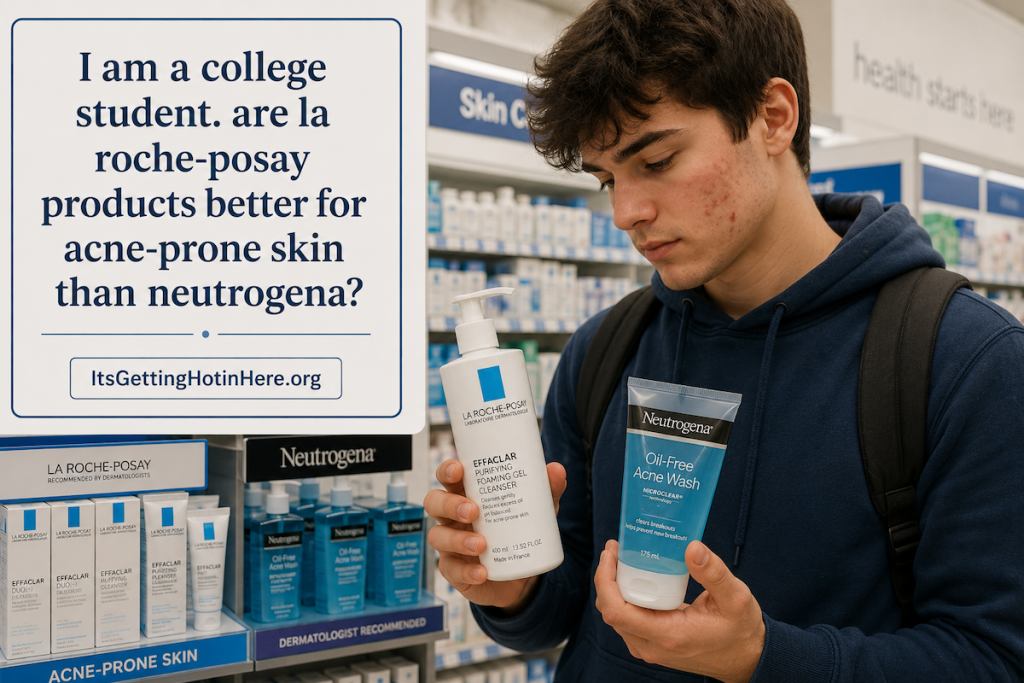
Somebody with very good skin told you the French one was worth it.
That is usually how this starts. They said it with total confidence, their face backed them up, and now you are standing in an aisle holding two bottles and quietly doing sums about the difference between them.
So: you are a college student, and you want to know whether La Roche-Posay products are better for acne-prone skin than Neutrogena. Every answer you will find picks one and explains why, generally at considerable length, and generally without mentioning what either product costs relative to a week of your groceries.
Here is a better place to start. There is something printed on the back of both of those bottles that decides whether the comparison you are making even makes sense, and almost nobody mentions it. It takes one second to check, it works on every product in that aisle, and once you have seen it the question gets easier and usually cheaper.
Turn them over.
Turn the Box Over
In the United States, a skincare product containing a recognized over-the-counter acne active is not sold as a cosmetic. It is regulated as a drug, and it has to carry a Drug Facts panel: a plain box on the packaging listing an active ingredient, a purpose, directions and warnings.
A product aimed at acne-prone skin that does not contain one of those actives is a cosmetic. It carries an ingredients list and no panel at all.
That is the whole distinction, and here is why it matters more than the name on the front. Both La Roche-Posay and Neutrogena sell products of both kinds. Each has cosmetics, and each has products carrying the panel.
So a great many of the comparisons you have read set a cosmetic from one brand against a treatment product from the other, decide which came out better, and announce a conclusion about brands. It is not a conclusion about brands. It is the difference between two categories of product that happen to share a shelf.
There is a language version of the same thing, and it is worth noticing. Acne-prone skin is a phrase from marketing. Acne is a word from medicine. A product sold for the first has not claimed anything about the second, and it does not have to.
None of which requires you to take my word for it. Pick up any two things in that aisle and look at the back. One second per product, every brand, for the rest of your life.
Where Neutrogena Sits
Neutrogena is the American mass-market option and it is everywhere. Drugstores, supermarkets, the shop attached to the gas station at a push. Cheap, enormous range, and it includes both cosmetics and products carrying the panel.
For somebody in your position the availability is not a minor detail. It is most of the value. You can buy it in a store you already walk through, replace it the day you run out, and try something without organizing your week around it.
There is a second benefit that matters more than it sounds. When a product is cheap, being wrong about it costs almost nothing. You can try something, decide it does not suit you, and get on with your afternoon. The freedom to be wrong cheaply is worth a great deal while you are still working out what your skin does.
The trade is the size of the range. There are a lot of products with similar names in similar bottles, and telling them apart takes longer than it should. Which is where the panel earns its keep again, because it separates them faster than the front of the packaging does.
Who it suits: anyone who wants to start now, locally, without turning it into a large decision, and who would rather learn from three cheap attempts than one expensive one.
Where La Roche-Posay Sits
La Roche-Posay is a French pharmacy brand, sold mainly through pharmacies and online rather than off a supermarket shelf, and priced several times above the drugstore band. Effaclar is the line this question is usually about.
What it does well is legibility. The range is narrower, the naming is more consistent, and the brand is unusually clear about which product is meant for what. If you have ever stood in front of a wall of near-identical bottles and quietly given up, that clarity is worth something real.
It has also aimed itself deliberately at people whose skin reacts to things, and the range is built around not causing trouble. That is a design decision rather than a slogan, and it shows in how the products are put together.
The trades, stated plainly. It costs several times more per item. It is harder to buy on a whim, which matters when you run out on a Sunday night. And a mistake is expensive enough to sting for a week.
One thing worth saying because nobody selling you anything ever will: a higher price is not evidence of anything. It reflects positioning, distribution and marketing at least as much as it reflects what is inside the bottle.
Who it suits: somebody who values a short, clear range and can absorb the price without thinking about it.
What the Extra Money Buys
Worth answering directly, because you are counting, and because the difference here is not a few dollars. It is the kind of gap where one bottle costs about what several of the other one would.
What the premium does buy, and this is real rather than a consolation prize: textures and finishes that a lot of people prefer, a narrower range that is quicker to choose from, and a brand built around not aggravating skin that is already unhappy about something. If you have found drugstore products harsh in the past, none of that is nothing.
What it does not buy is a different category of product. If both bottles in your hands carry the panel and both name the same kind of active, you are holding two products of the same regulatory type at very different prices. Worth knowing before you decide the price gap represents a quality gap.
And here is the part that decides it for a student. A cheaper product used every day beats an expensive one used carefully. Rationing is the most common way skincare fails, and rationing is exactly what happens when a bottle costs enough to make you think about each pump. The expensive option stops working the moment you start saving it.
So the honest answer is not that the cheap one is secretly as good. It is that consistency beats specification, and consistency is much easier to afford.
Where Each One Is Genuinely Stronger
A fair comparison now, on the things that can honestly be compared. Both of these companies are good at what they do, and they are good at different parts of it.
Neutrogena is stronger on availability, on price, and on the sheer number of options, which matters when the first thing you try does not suit you and you want a second attempt this week rather than next month.
La Roche-Posay is stronger on clarity of range, on consistency between products, and on texture and finish. That last one is a preference rather than a performance claim, and it is a preference plenty of people are perfectly happy to pay for.
Notice what is missing from both of those lists. Neither says one works better than the other. That is deliberate, because nobody writing a webpage has tested anything on your face, and somebody who tells you otherwise is describing their own skin and calling it a review.
One practical note, and then this article will stop talking about medicine. Acne that is painful, leaving marks, or simply not shifting is worth taking to a pharmacist or a doctor rather than to another comparison article. If you are at college, student health services usually cover exactly this, and it is a far shorter route to an answer than the aisle is.
What to Do on a Student Budget
None of the following mentions a brand, and that is the point. The things that decide how this goes for you are not brand decisions.
- Read the panel before you compare prices. Two products of different regulatory types are not really competing, so the gap between their prices tells you nothing useful.
- Buy the cheap version of anything you have never used. If it suits you, moving up later is easy. If it does not, you have lost the price of a coffee rather than a week of food money.
- Change one thing at a time. Two changes at once and you learn nothing from either, which means paying twice for a single piece of information. Give each one long enough to be worth judging before the next one arrives.
- Spend where you use it daily. Money in the thing you touch every morning does more work than money in the occasional extra sitting behind it. If the budget only stretches to upgrading one item, upgrade that one.
- Patch test on the inside of your forearm for a day before anything new goes near your face. A day of waiting is a much better trade than a fortnight of regretting it in seminars.
Every one of those is free or nearly free, and none of them asks you to take a side in an argument between two large companies. The decision that matters is not which brand. It is whether you will still be able to afford it in six months. A routine that ends when the money does was never a routine, it was a purchase.
Try It Before You Own It
One more thing, and it is the cheapest advice in this article.
The most wasteful purchase in this entire category is the full-size bottle bought on somebody else’s recommendation and abandoned a fortnight later. Not because the product was bad. Because it was never tested on the person who bought it.
That bottle then sits at the back of a shelf until it is old enough to throw out, and the money and the plastic go the same way together.
Students are unusually well placed to dodge this. You live among people who already own these things. Asking a housemate for one use of theirs, or taking a sample where a counter offers one, costs nothing and answers the only question that matters, which is what your own skin does with it.
It is a small habit and it compounds quickly. Less bought, less wasted, less thrown away, and noticeably more of your money still in your account at the end of term. Nobody is going to sell you this idea, because there is nothing in it for anybody with something to sell.
Frequently Asked Questions
The questions that come up most often once someone has got this far, answered straight.
Is La Roche-Posay good for acne-prone skin?
It is a brand built for skin that reacts easily, and the Effaclar line is aimed squarely at this. Whether a specific product suits you is a question about your skin rather than about the brand, and the only way to find out is to try one thing and pay attention.
Which is better, Neutrogena Hydro Boost or La Roche-Posay?
That comparison is a neat example of the problem. Hydro Boost is a hydrating range rather than an acne one, so setting it against an Effaclar product means comparing two things built for different jobs. Work out what each is for before deciding which won.
What are the best brands for acne-prone skin?
There is no ranked list that applies to everybody, and any article handing you one is guessing on your behalf. Both of these brands are widely used and easy to find. Start with what you can buy locally and afford to keep buying.
Is Neutrogena good for acne?
Neutrogena sells both cosmetics and products carrying a Drug Facts panel, so the answer depends entirely on which of its products you mean. The panel tells you which is which, and persistent acne is worth taking to a pharmacist or a doctor.
Can I use both brands together?
Yes. A cleanser from one and a moisturizer from the other will not conflict, and plenty of people end up mixing once they stop trying to own a matched set. Introduce anything new on its own so you know what caused what.
Is La Roche-Posay worth it on a student budget?
Sometimes, and rarely first. If you are a college student wondering whether La Roche-Posay products are better for acne-prone skin than Neutrogena, start with the cheaper option used consistently, and treat the premium as an upgrade you make for a reason rather than a place to begin.
La Roche-Posay or Neutrogena? Check the Panel, Then Check Your Budget
Read the panel first, so you know whether the two things you are comparing are even the same kind of thing. Then, on a student budget, start with the cheaper one and use it properly. Move up when you have a reason, not because somebody with good skin told you to.
Both brands are competent and both are used by millions of people, and the gap between them is smaller than the gap between using something every day and using it when you remember.
The one thing genuinely worth carrying out of this is the panel itself. It works on every box in every aisle, on brands neither of us has heard of, for as long as you keep buying skincare at all.
And your friend was not lying to you. They were telling you the truth about their own face, which is the only face they have ever tested anything on. So if you are a college student wondering whether La Roche-Posay products are better for acne-prone skin than Neutrogena, the honest answer is that the back of the bottle will tell you more than they can, and it is free.